November 15, 2009


The machine of a dream
And then, her third question was: "And do you have a car there?"
"No, I don't have a car: I either want it nor need it".
This has been, up to now, the best third-question ever. Just remember this while listening to one of the best songs by Queen (this one is a great video).
Yes, cars are still machines of dreams... Not to talk about other interpretations of the song...
November 12, 2009
Malcolm de Chazal dixit
 "The sense of beauty varies from age to age in the track of fashion and progress. Charm alone, from yesterday until the end of time, remains golden and invariable".
 "Blue is the acme of purity. Losing yourself in contemplation of the azure sky above washes and cleanses your eyes. After a bath your eyes shine with a blue look".
 "We seek out blue, yellow comes to us. The ray of light comes to us, we look for the azure sky. A yellow dress offers itself; blue asks to be taken. Yellow is for women looking for love; blue for available windows".
 "The iris is to the eye what pigment is to the skin, a kind of inner lampshade. The blacker the iris, the more it concentrates the look in the center of the face and "solders" the features together".
November 11, 2009
Toda clasificación es arbitraria
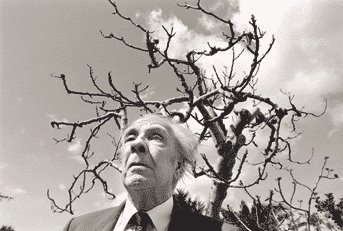
Releo El idioma analítico de John Wilkins, y transcribo parcialmente el párrafo decisivo:
November 10, 2009
"A l'Allemagne", par Victor Hugo
 Aucune nation n'est plus grande que toi ;
Jadis, toute la terre étant un lieu d'effroi,
Parmi les peuples forts tu fus le peuple juste.
Une tiare d'ombre est sur ton front auguste ;
Et pourtant comme l'Inde, aux aspects fabuleux,
Tu brilles ; ô pays des hommes aux yeux bleus,
Clarté hautaine au fond ténébreux de l'Europe,
Une gloire âpre, informe, immense, t'enveloppe ;
Ton phare est allumé sur le mont des Géants ;
Comme l'aigle de mer qui change d'océans,
Tu passas tour à tour d'une grandeur à l'autre ;
Huss le sage a suivi Crescentius l'apôtre ;
Barberousse chez toi n'empêche pas Schiller ;
L'empereur, ce sommet, craint l'esprit, cet éclair.
Non, rien ici-bas, rien ne t'éclipse, Allemagne.
Ton Vitikind tient tête à notre Charlemagne,
Et Charlemagne même est un peu ton soldat.
Il semblait par moments qu'un astre te guidât ;
Et les peuples t'ont vue, ô guerrière féconde,
Rebelle au double joug qui pèse sur le monde,
Dresser, portant l'aurore entre tes poings de fer,
Contre César Hermann, contre Pierre Luther.
Longtemps, comme le chêne offrant ses bras au lierre,
Du vieux droit des vaincus tu fus la chevalière ;
Comme on mêle l'argent et le plomb dans l'airain,
Tu sus fondre en un peuple unique et souverain
Vingt peuplades, le Hun, le Dace, le Sicambre ;
Le Rhin te donne l'or et la Baltique l'ambre ;
La musique est ton souffle ; âme, harmonie, encens,
Elle fait alterner dans tes hymnes puissants
Le cri de l'aigle avec le chant de l'alouette ;
On croit voir sur tes burgs croulants la silhouette
De l'hydre et du guerrier vaguement aperçus
Dans la montagne, avec le tonnerre au-dessus ;
Rien n'est frais et charmant comme tes plaines vertes ;
Les brèches de la brume aux rayons sont ouvertes,
Le hameau dort, groupé sous l'aile du manoir,
Et la vierge, accoudée aux citernes le soir,
Blonde, a la ressemblance adorable des anges.
Comme un temple exhaussé sur des piliers étranges
L'Allemagne est debout sur vingt siècles hideux,
Et sa splendeur qui sort de leurs ombres, vient d'eux.
Elle a plus de héros que l'Athos n'a de cimes.
La Teutonie, au seuil des nuages sublimes
Où l'étoile est mêlée à la foudre, apparaît ;
Ses piques dans la nuit sont comme une forêt ;
Au-dessus de sa tête un clairon de victoire
S'allonge, et sa légende égale son histoire ;
Dans la Thuringe, où Thor tient sa lance en arrêt,
Ganna, la druidesse échevelée, errait ;
Sous les fleuves, dont l'eau roulait de vagues flammes,
Les sirènes chantaient, monstres aux seins de femmes,
Et le Harz que hantait Velléda, le Taunus
Où Spillyre essuyait dans l'herbe ses pieds nus,
Ont encor toute l'âpre et divine tristesse
Que laisse dans les bois profonds la prophétesse ;
La nuit, la Forêt-Noire est un sinistre éden ;
Le clair de lune, aux bords du Neckar, fait soudain
Sonores et vivants les arbres pleins de fées.
O Teutons, vos tombeaux ont des airs de trophées ;
Vos aïeux n'ont semé que de grands ossements ;
Vos lauriers sont partout ; soyez fiers, Allemands.
Le seul pied des titans chausse votre sandale.
Tatouage éclatant, la gloire féodale
Dore vos morions, blasonne vos écus ;
Comme Rome Coclès vous avez Galgacus,
Vous avez Beethoven comme la Grèce Homère ;
L'Allemagne est puissante et superbe.
November 9, 2009
Berlin Wall 20|09


Today there was a ceremony with Walesa, Gorbachov, Merkel and Wowereit.





Now let's tear down many other diving walls we have!
November 7, 2009
Red barriers: Maradona, Tank Man
 Maradona vs. Belgium (June 13, 1982)
 Unknown Man vs. Red China (June 5, 1989)
Maradona 2 - Inglaterra 0
 Mario Benedetti: "Aquel gol que le hizo Maradona a los ingleses con la ayuda de la mano divina es, por ahora, la única prueba fiable de la existencia de Dios".
 Víctor Hugo Morales: "Balón para Diego, ahí la tiene Maradona. Le marcan dos. Pisa la pelota. Maradona (...) arranca por la derecha el Genio del Fútbol Mundial. Inicia el contraataque e intenta contactar con Burruchaga... Siempre Maradona. ¡Genio, genio, genio ! Ta, ta, ta, ta... ¡Gooooool, gooooool y goooool! ¡Qué golazo! Dios Santo, viva el fútbol. Golaaazo. Diegoool Maradona. Es para llorar, perdonénme. Maradona en recorrida memorable, en la jugada de todos los tiempos. Barrilete cósmico, ¿de qué planeta viniste para dejar en el camino a tanto inglé,s para que el país sea un puño apretado gritando por Argentina? Argentina 2, Inglaterra 0. Diegoool, Diegoool, Diego Armando Maradona. Gracias, Dios, por el fútbol, por estas lágrimas y por este Argentina 2, Inglaterra 0".
November 6, 2009
Fra Angelico's parrot-angels
Two weeks ago, we went to see a little church in San Domenico, close to Firenze, where Fra Angelico painted his first work. While I was wondering about the blond hair of Mary and Jesus, as it seemed to me that it was an ideal of beauty at that time, T pointed out the colorful wings of the angels. America's and Australia's parrots were still unknown in Europe, so it all was Angelico's imagination.
 Fiesole Triptych (detail), 1424-1430
 Madonna and Child with Angels, c. 1425 (Hermitage, St. Petersburg)
 Madonna Surrounded by Angels, c. 1429 (Frankfurt am Main)
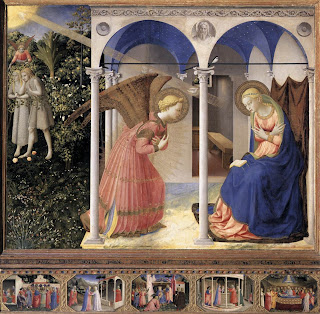 First: Altarpiece of the Annunciation, c. 1430-1432 (Museo del Prado, Madrid)
 Second: Altarpiece of the Annunciation, c. 1430-1432 (Museo del Prado, Madrid)
 Annunciation, c.1432-1434 (Museo Diocesano, Cortona)
 xxxxx
xxxxx 
Linaioli Tabernacle (details), 1433 (Museo di San Marco, Firenze)
 Perugia Triptych: Angel of the Annunciation, 1437 (Galleria Nazionale dell'Umbria, Perugia)
 Annunciation, c. 1441 (Museo di San Marco, Cell 3)
 Annunciation, c.1450 (Museo di San Marco, Corridor)
 Armadio degli Argenti (detail), c.1450 (Museo di San Marco)
November 5, 2009
Thomas Jefferson on Not Traveling
Dear Peter,
 Traveling makes men wiser, but less happy. When men of sober age travel, they gather knowledge, which they may apply usefully for their country, but they are subject ever after to recollections mixed with regret—their affections are weakened by being extended over more objects, and they learn new habits which cannot be gratified when they return home. Young men who travel are exposed to all these inconveniences in a higher degree, to others still more serious, and do not acquire that wisdom for which a previous foundation is requisite, by repeated and just observations at home. The glare of pomp and pleasure is analogous to the motion of the blood—it absorbs all their affection and attention, they are torn from it as from the only good in this world, and return to their home as to a place of exile and condemnation. Their eyes are forever turned back to the object they have lost, and its recollection poisons the residue of their lives. Their first and most delicate passions are hackneyed on unworthy objects here, and they carry home the dregs, insufficient to make themselves or anybody else happy. Add to this that a habit of idleness—an inability to apply themselves to business—is acquired and renders them useless to themselves and their country. These observations are founded in experience. There is no place where your pursuit of knowledge will be so little obstructed by foreign objects, as in your own country, nor any, wherein the virtues of the heart will be less exposed to be weakened. Be good, be learned, and be industrious, and you will not want the aid of traveling, to render you precious to your country, dear to your friends, happy within yourself. I repeat my advice to take a great deal of exercise, and on foot. Health is the first requisite after morality. Write to me often, and be assured of the interest I take in your success, as well as the warmth of those sentiments of attachment with which I am, dear Peter, your affectionate friend.
(Source)
November 2, 2009
José Clemente Orozco, Peter Eisenman, Metropolis

Le Corbusier: "Les architects ont aujourd'hui peur de la géométrie des surfaces. L'architecture est le jeu savant, correct et magnifique des volumes assemblés sous la lumière".
.jpg)


