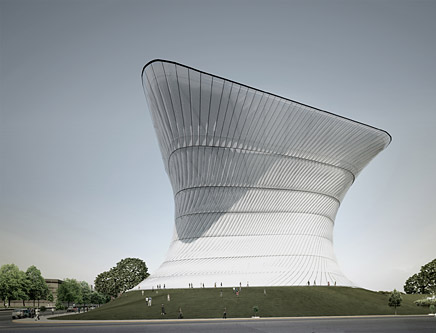
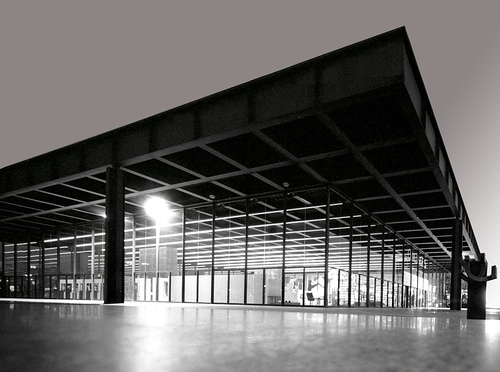
Fernando Romero is in Berlin, and we had lunch together today. He was talking about Thomas Demand, an artist I didn't know, because this afternoon was the vernissage of his new exhibition in the Neue Nationalgalerie of Mies.
Since I practically lived in Berlin's Brain on a daily basis for a couple of years, I showed him the building. That was the first time I visited the library with an architect, and his sight was, of course, very different from mine. Not only the sight, but also the experience: architects are much more interested in materials than us, non-architects, so they are touching everything. There are for instance those short walls, which I never took seriously, and if you had asked me, I would had said they were made of some synthetic plastic or so. But no! They are pure steel.
The next idea was to see the new museum by David Chipperfield, but the taxi driver blew it up. And then, well, in the evening, I went to Demand's exhibition. I had no idea, but it is ok. He is making little models based on old pictures he has found on newspapers. The models are made of paper, mostly. But in a perfect way. Without people, without brand names, without letters. Emptiness. Just the objects and the colors. Then he makes a picture of them, prints it out in real format, so the result is that you see a bathtub in which you would like to have a bath, but there is something strange about it. Demand is a very cultivated artist, so every single picture has a solid intellectual background, going from photophobia to the concept of memory according to Proust or Beckett.
This was an architectural day, in all senses, from big, great buildings like Foster's or Mies' to small models by Demand, whose exhibition, by the way, paradoxically blocks the emptiness of the building, he, the artist who is so concerned about emptiness. Strange.
Corrigenda: I have been reading about this exhibition, and it seems that the idea of hanging those curtains in the Neue Nationalgaleria was, actually, Mies' own proposal.
Arab people call it "Dead Sea", but the original name is "Salt Sea" (FB group). It is an amazing experience going there. I had been looking forward to swim there since I was a little kid, because my grandparents told me about it, and I had been very curious for more than 20 years. I finally went there, and swam there. More than swimming, I just floated.
You have to be very careful about the water coming into your eyes or mouth or nose. Just a few drops of water reached my lips, and that was enough to be very thirsty the whole night. I touched my eyes with dried hands after swimming, and that was enough to wake up next morning with an itchy pain in them.
Other tourists were doing the typical photo of reading a newspaper while floating, but I was too happy to be there, that I just wanted to enjoy the experience without being distracted by a camera. There is no sand or soil or whatsoever, but just salt. Freakies put mud on their bodies to get good vibes.
I spent the whole night at the beach, perfect windy weather (refreshing wind in the middle of the desert), slept in my sleeping bag, and woke up on time: it was already clear, but there was still no sun in the sky. In front of me, the mountains of Jordania. Very slowly they became on fire, till the sun was there. One more sunny day in this desert, the lowest point on Earth.
Now I am really curious about going to Lac Assal, in Djibouti, the lake with the highest salinity: up to 50% (Salt Sea's is "just" 33%). One sunny day!
The most boring and uninteresting paintings are still lifes. No doubt about it. The first one I saw in my life hanged, and still hangs, at my grandparents' place, in the dinning room. I couldn't understand it, so meaningless and without life. Whenever I bump into one in a museum or a book, I rather look away. At least I was doing that most of the times, till the moment when I saw some years ago Van Gogh's "Still life with absinthe" (1887). This was the first still life I had seen with movement and life: people walking in the street. That seemed to me a fake still life, it looks more like a picture of a bar: somebody was drinking, a girl or a friend or an acquaintance entered, and the guy stood up to have a small talk. Or maybe there was a fight and a duel, and the absinthe was left behind. Or perhaps that is the fourth bottle and he went to the toilette, or is lying on the floor. Who knows. The crucial fact for me is the life.
So I started doing my own "fake still lifes" à la Van Gogh, where people interact with still-life-people, say an advertisement, a picture, a painting, a grafitti, a doll... These are some of my Israel "fake still lifes" from last week. The first one was taken in Jerusalem's market, and the rest in the non-turistic slums of Tel Aviv.
It seems to me impossible what Spaniards did: To explain to old Aztecs that cannibalism was something wrong and forbidden, and that receiving the Communion, i.e. eating and drinking Jesus' flesh and blood was something holy.
Somehow they succeeded. The result was, at some extent, the tequitqui art, like this example of Tonantzintla's church.
Perhaps that stuff that seems impossible today will find it's way out and bring out an incredible offspring. "Es wird nur besser", said somebody recently. Check Tonantzintla.
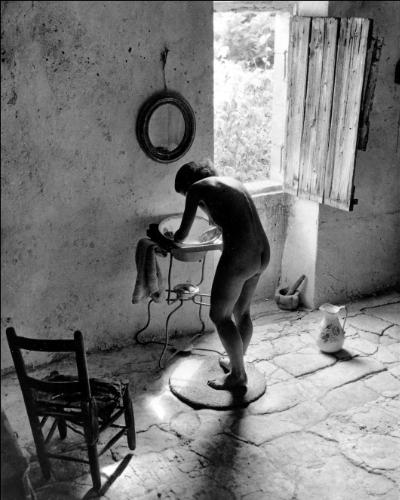
Yesterday passed away the great photographer Willy Ronis. He was the contemporary version of Atget. His last exhibition was in winter 2005-2006, in Hôtel de Ville. Although I spent 10 days in Paris during that time, I didn't manage to visit it, since I was full time in Hôtel Dieu.
One of his most popular Provenzal pictures has been compared to Bonnard's painting.
Three years ago I started checking daily the music blog Filles Sourires (this week celebrating the 4th anniversary!), which changed completely the way I hear music, and encouraged my love to French music. Since then I had checked some other blogs, and also became a constant reader of Aurgasm, a blog which had an amazing display till few days ago, when they started putting too many pics. And sometimes I throw a glance to Coverfreak.
I didn't succeed reading Ternura Porno, which seemed to me boring, poor creative and egocentric. I didn't manage either to understand how Motel de Moka was working, till now, when I checked it again after one and a half or two years. This is one of the most popular music-blogs by Mexicans, although it does not concentrate on Mexican music.
Before using music blogs, previous attempts like Napster were in my case not that successful. I didn't succeed either listening to radio online, and my experience using Pandora, that page which was suggesting you all the time similar songs / bands, lasted a couple of weeks.
That is my account. If you fancy, you can also read Nick Hornby's, published last Sunday on The Guardian.
S and K got married last week in Amuqqa, Galilee, so I went to a week-trip to Israel doing couchsurfing. It was my first experience doing that, although I had surfed other couches before, but always from people I knew or friends of friends. This time was going to people I had never seen before. So I chose them according to the pics and their mails. I had two very nice hosts, ED in Jerusalem and SB in Tel Aviv.
I was amazed by the kindness and generosity of these girls, and I had a great time in both cities. ED told me about Eran Bar-Gil's project "1:1", which sounds great (I just found one song on YouTube, not the best one), and SB brought me to the best sushi ever.
Surfing couches in Israel is a life experience, due to the cosmopolitanism of the population. They all travel a lot, know many languages and are extremely kind. I though that Mexicans were good hosts, but that is not to compare with Israelis. Other couchsurfers even offered me to leave me the key since I was planning to come when they weren't at home.
CouchSurfing seems to be a little utopia where everybody is nice and looking forward to help each other. The only problem I know about happened just few weeks ago. It is the sad story iof a male Marrocan host who abused his guest, a girl from Hong Kong traveling through Europe.
Of course this kind of things can happen. It is a very close relation you establish with unknown people, and you shouldn't be naïve or stupid. I was very lucky and had a great great time, specially in Tel Aviv. I even tried to postpone my plane to Berlin, but it was impossible. I will go back there soon, in any case.
Hace un mes trabajamos en la oficina en una serie de artículos breves dedicados a las vacaciones de los presidentes. Investigando eso fue como me enteré de que Calderón pasó sus vacaciones de semana santa encerrado en una base militar en Acapulco, por miedo a los narcos. Me fue imposible encontrar a dónde iría este verano, parece ser secreto.
También leí acerca de las vacaciones lujosas y escandalosas de los hijos de Hugo Chávez, y de las vacaciones de los Kirchner en El Calafate, que mi colega Andreas califica como lugar horroroso por el cual hay que pasar si se quiere ir al imponente glaciar Perito Moreno.
Así que con este telón de fondo, los editores de "Letras Libres" me pidieron un post para el Blog de la Redacción. Fue complicado, pues estaba en Italia. Regresé a Berlín, me entretuve con muchos pendientes urgentes, y a tres horas de partir rumbo a Israel, empecé el texto. Me basé fundamentalmente en el trabajo que habíamos hecho ya en la oficina, y pude terminarlo en Jerusalén.
Un texto sobre el "penacho de Moctezuma" que publiqué en el más reciente número de "Letras Libres".
Y una coda:
"Cuando este artículo estaba ya en la imprenta, me contó el Prof. Feest que acababa de estar el pasado mes de julio en México con ocasión del Congreso Internacional de Americanistas. En reunión con Alfonso María y Campos, Director General del INAH, se decidió establecer una comisión técnica mexicano-austriaca que valorará el estado de conservación del tocado náhuatl, y la posibilidad de trasladarlo. Aún no hay una fecha concreta, quizá sea el próximo año".
Went today to Masada, one extraordinary achievement of human military fortification and urban design. I could write a lot about how the Jews built in the middle of the desert, on the top of a hill, a city with swiming pools, thermal baths, palaces and more than 25 water containers.
Romans attacked the city with 8000 soldiers, and it lasted months, till they managed to defeat them. In order to get into the city they built a ramp from the soil to the city wall. An extraordinary military action.
I remembered what Mark Twain says about Italians. His remark was concerning the Venetian Republic, but it can also be said about the old Romans. They were such brave soldiers and amazing fighters; and it is a pity and a little bit ridicoulous that nowadays Italians are not well known because of that but because of their metrosexuality. (Of course Twain's words are far funny.)
Following Jack Bauer, just started this very second the Berliner version of "24": 24 hours in the life of the city, nonstop, full of life and people, a profile of the best city to live. Watch it on Arte, rbb, online, or wherever in the city...At least you can. I cannot, here in Israel.
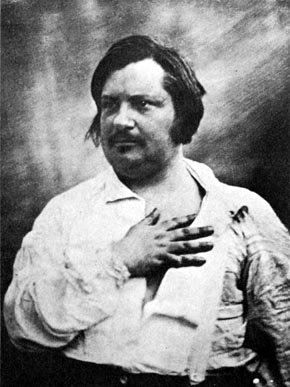
It is well known that Balzac was crucial in the romantic relationship between literature and coffee. He was not only a brave coffee drinker, but was also praising this beverage brought from the New World a couple of centuries before. He was drinking up to 50 cups per day, some say.
One day, short after his wedding, Victor Hugo visited him. That night Balzac died. Some say, that disease had somehow caused by the coffee. Who knows.
I haven't read Balzac, and I haven't drink coffee in my life, except in both cases for little exceptions. I don't like hot beverages like coffee or tea, I prefer a hot soup.
But I have read almost all novels by Jules Verne. I don't know if he liked coffee, or not, but he loved writing about crackers. In most of his adventure novels, in the first chapters, when he is describing the supplements needed for the expedition or adventure about to start, people never ever forget to pack many pounds of crackers.
Crackers were invented in Massachusetts by a certain Theodore Pearson of Newburyport in 1792, and comercialized 9 years later. By 1810 they were a big success among sailors and soldiers. Another product from the New World with which a French novelist falled in love with.
And me as well. I devour them. Saladitas Santos (now owned by Gamesa and comercialized only as "Saladitas") seemed to me the biggest invention, and for decades I was unable to find something similar -- even though I have tried tons of crackers of all styles and brands.
Till last week, when I realized that Saladitas Santos might be a copy of Italian crackers. They have almost the same shape and size, the same salty, dried flavor, and almost the same package. Now I start to suspect that Saladitas Santos is a copy of some Italian crackers.
Visited Siena last Sunday for the first time. One of the nicest cities where there is "nothing" to see, like in bloody (and overrated, and dirty, and crowded) Florence, except for the city itself. Siena is not a city to go and see things, but to enjoy the atmosphere, a place to stay, a small city to be in. To sit and let the time fly away, and fade...
The Piazza del Campo was paved in 1349, and it has a kind slope. A similar slope is in front of Parisian Centre Pompidou. Who knows if that is a coincidence or not.
"Oliver was a young lawyer, fresh from the schools, who had gone out to the deserts of Nevada to begin life. He found that country, and our ways of life, there, in those early days, different from life in New England or Paris. But he put on a woollen shirt and strapped a navy revolver to his person, took to the bacon and beans of the country, and determined to do in Nevada as Nevada did. Oliver accepted the situation so completely that although he must have sorrowed over many of his trials, he never complained -- that is, he never complained but once. He, two others, and myself, started to the new silver mines in the Humboldt mountains -- he to be Probate Judge of Humboldt county, and we to mine. The distance was two hundred miles. It was dead of winter. We bought a two-horse wagon and put eighteen hundred pounds of bacon, flour, beans, blasting-powder, picks and shovels in it; we bought two sorry-looking Mexican "plugs," with the hair turned the wrong way and more corners on their bodies than there are on the mosque of Omar; we hitched up and started. It was a dreadful trip. But Oliver did not complain. The horses dragged the wagon two miles from town and then gave out. Then we three pushed the wagon seven miles, and Oliver moved ahead and pulled the horses after him by the bits. We complained, but Oliver did not. The ground was frozen, and it froze our backs while we slept; the wind swept across our faces and froze our noses. Oliver did not complain. Five days of pushing the wagon by day and freezing by night brought us to the bad part of the journey -- the Forty Mile Desert, or the Great American Desert, if you please. Still, this mildest mannered man that ever was, had not complained. We started across at eight in the morning, pushing through sand that had no bottom; toiling all day long by the wrecks of a thousand wagons, the skeletons of ten thousand oxen; by wagon-tires enough to hoop the Washington Monument to the top, and ox-chains enough to girdle Long Island; by human graves; with our throats parched always, with thirst; lips bleeding from the alkali dust; hungry, perspiring, and very, very weary -- so weary that when we dropped in the sand every fifty yards to rest the horses, we could hardly keep from going to sleep -- no complaints from Oliver: none the next morning at three o'clock, when we got across, tired to death.
Awakened two or three nights afterward at midnight, in a narrow canon, by the snow falling on our faces, and appalled at the imminent danger of being "snowed in," we harnessed up and pushed on till eight in the morning, passed the "Divide" and knew we were saved. No complaints. Fifteen days of hardship and fatigue brought us to the end of the two hundred miles, and the Judge had not complained. We wondered if any thing could exasperate him. We built a Humboldt house. It is done in this way. You dig a square in the steep base of the mountain, and set up two uprights and top them with two joists. Then you stretch a great sheet of "cotton domestic" from the point where the joists join the hillside down over the joists to the ground; this makes the roof and the front of the mansion; the sides and back are the dirt walls your digging has left. A chimney is easily made by turning up one corner of the roof. Oliver was sitting alone in this dismal den, one night, by a sage-brush fire, writing poetry; he was very fond of digging poetry out of himself-- or blasting it out when it came hard. He heard an animal's footsteps close to the roof; a stone or two and some dirt came through and fell by him. He grew uneasy and said "Hi! -- clear out from there, can't you!" -- from time to time. But by and by he fell asleep where he sat, and pretty soon a mule fell down the chimney! The fire flew in every direction, and Oliver went over backwards. About ten nights after that, he recovered confidence enough to go to writing poetry again. Again he dozed off to sleep, and again a mule fell down the chimney. This time, about half of that side of the house came in with the mule. Struggling to get up, the mule kicked the candle out and smashed most of the kitchen furniture, and raised considerable dust. These violent awakenings must have been annoying to Oliver, but he never complained. He moved to a mansion on the opposite side of the canon, because he had noticed the mules did not go there. One night about eight o'clock he was endeavoring to finish his poem, when a stone rolled in -- then a hoof appeared below the canvas -- then part of a cow -- the after part. He leaned back in dread, and shouted "Hooy! hooy! get out of this!" and the cow struggled manfully--lost ground steadily--dirt and dust streamed down, and before Oliver could get well away, the entire cow crashed through on to the table and made a shapeless wreck of every thing!
Then, for the first time in his life, I think, Oliver complained. He said,
"This thing is growing monotonous!"
Then he resigned his judgeship and left Humboldt county."
I am posting now from this very building on the top of San Domenico's hill, between Florence and Fiesole. The history of the area is interesting. Some followers of Saint Peter were executed in the first century where the church now stands: Saint Romulus and his friends. (Mark Twain observes that in Roman times, the government was offering to the people violent amusement while taking rid of their new "enemies", the Christians, in order to protect their own interests). Then Cosimo de' Medici (the Elder) decided to build a bigger church, this one on the pic.
But the family de Medicis had troubles and decayed. Till Charles V helped them and restored the old name of the family. At that very time, Filipinos, people from Tierra del Fuego up to Colorado or even Montana, people from Cádiz and south Germany, people from Florence, all of them were under the same flag and crown and scepter. That accounts to a first and political globalization.
Then Cosimo (the Younger) build also his library next to the church, the building on the left, today it belongs to the European Institute University and a community of two friars. Here is where I am now, in the library, full of Ph.D. students from all different countries, most of them Europeans.
The Habsburg Empire under the rule of Charles V is the most impressive "globalization" considering the technical limitations. Such a huge territory couldn't be governed by a single head. But it is still a strange feeling to consider that once upon a time the people living here and the people living in Mexico belonged to a single "country".
The predict of Saint Peter and the blood of Saint Romulus began long before the Habsburg another kind of (religious and political) pre-globalization: Christianity. The Spanish Empire of the XVIth century was built on it. Somehow here, on this hill, are some of the oldest roots...
Some weeks ago, FAZ newspaper asked me to go to the Amazonas and check the situation there between the indigenous groups, the oil companies, and the ecoturism. I am still working on my report, but Lloyd Alter posted something already about our trip in the famous blog Treehuger, as well as some pics of the fauna we saw there.
The sloth on the picture is important. While swimming in a little lake full with piranhas and caimans, the people in the shore started yelling: "Caiman, caiman!". Two guys jumped out of the water in half a second, but it was this sloth you see there. It had fallen into the water, was exhausted and close to get drowned, so some guys saved him.
The thing is that caimans eat fishes (specially piranhas) and small mammals. They rarely attack humans. And they sleep during the day. Piranhas just attack if there is blood. Since there was no blod and it was during the day, I swam for more than 20 minutes in the lake. An experience full of adrenaline, in any case.
This afternoon I finally went to the Uffizi. It is a shame! If you hadn't reserved your tickets online, you wait hours in the queue. In any case, they are expensive (plus the reservation charges). Anyways. The paintings are ok (full of saints, as Mark Twain was complaining). The sad thing is that the explanations are missing: with such a great collection (and those prices and a constant flow of visitors from all countries), they should have a friendly and more professional museography, instead of those domestic pieces of paper printed 15 or 20 years ago. It is so bad, that some funny guy damaged a Botticelli with masking tape. The sign to visit the "area" reserved to Caravaggio is an A4 paper in plain Arial fonts.
Italy should be ashamed of treating this art pieces so badly.
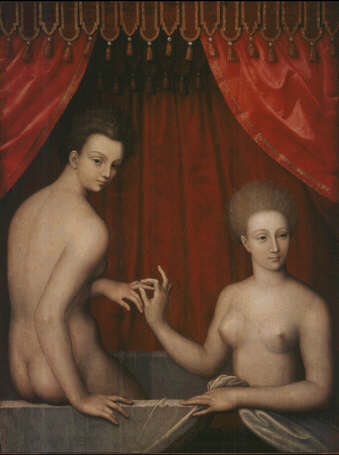
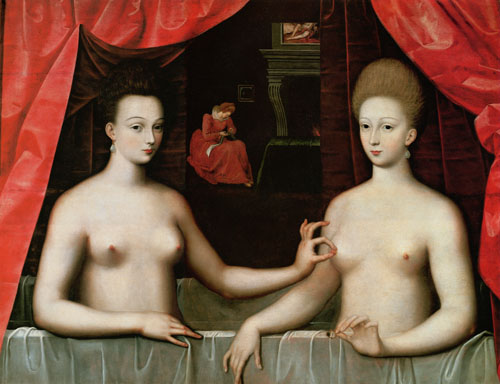
Interesting was to "discover" another portrait of Gabrielle d'Estrées, Duchess of Beaufort and Verneuil, Marchioness of Monceaux, Lover of the King Henry IV. She is the one who convinced the King to end the religious wars. "Paris is well worth a Mass", he famously replied. A similar portrait is in the Louvre, with Gabrielle and her sister are also taking a bath.
Cerca de Latacunga, en los Andes ecuatorianos, veo una bandera con los colores del arcoiris. Supongo que es casa de unos gays, pero luego veo otra, y otra, y otra, hasta que me explican que es la bandera del partido Pachakutik, de raigambre indígena. Viéndola con atención es mínima la diferencia con la bandera gay: tiene una línea violeta abajo. (Acorde, supongo, a la discusión sobre el cian y el índigo ocasionada por Newton, quien quería a fuerzas que fueran siete los colores primarios para que cuadraran con las notas musicales, los planetas, los días de la semana, y, así, incorporó el índigo.)
Otros muchos ejemplos de arcoiris ondeantes, como la italiana de la Pace, que colgaba de todos los balcones cuando Bush comenzó sus contraataques después del 11 de septiembre.
Y ésta es la bandera propuesta por Rem Koolhaas para la Unión Europea, basada a su vez en las banderas de los países.
Esta observación minuciosa de los colores del arcoiris me recuerda anthelion que vi el pasado 2 de abril en los suelos aún húmedos de los valles toscanos. No pude tomar ninguna foto, pero era algo parecido a esto que se ve acá abajo.
Last week I had to be in five different airports: the biggest one being Heathrow, the smallest one was Quito's VIP terminal (VIP doesn't stand for Very Important People, it is just the name of the airline), which is as small as my flat. All in all I spent like 30 hours of the last week in airports. A lot. Very bad for people like me who doesn't like them.
Airports have something repulsive. They are places of transit, being the rolling bands their perfect symbol: going, coming back, going, rolling, moving always in or out, the only two movements allowed: ir y venir, hin und her. Period. Too much movement contrasts with the limitation of those two possible movements. That is exactly why people move so fast, trying to get out of the airport as soon as possible, since it is not more than a necessary condition in order to be there, in the desire destination (where all kinds of movements are possible: up and down, in circles, left or right, backward and forward, zigzag...).
Now, airport designers are trying (unsuccesfully) to make them "a nice place to stay" or "to spent the time". That is a contradictio in terminis, since an airport is by itself a temporary place. But since there is always an exception to confirm the rule, Sir, Alfred Mehran's lived 18 years in the Terminal 1 of Parisian airport Charles de Gaulle.
The same can be said about bridges: two directions to go, a "place" to connect to real places. Following the "stay-in-the-airport-philosophy", some architects want to transform bridges into places of staying, specially in China. One of these bridges "should provide for a dedicated space on the river, a room over the water, more than merely acting as an engineering device that solves a communication problem." Mexican architect Fernando Romero finished already one in Jinhua City, China, and is working on another similar project in Matamoros, Mexico.
(The Ponte Vecchio is an exception worth of mentioning, since it has always hosted some houses and shops.)
Some of the most beautiful (Chinese) bridges are the lángqiáo, built by the Dong people. They serve the basic purpose of crossing a river in order to join two shores. Plus: The roofs offer a shelter for wind and rain. They are beautifully designed, and are not intellectually pretentious.
This way or that way, as you wish, just keep walking. Do not stop. Not in airports and bridges.
Just came back from Amazonas and the Andes. I missed two creatures I was looking forward to see: the river dolphin (I was indeed in the area, but they left some time ago up the river due to the oil pollution), and the transparent butterfly, which I could just see on pics. That reminded me of the fish with transparent head, and other transparent creatures.
 Fernando Romero is in Berlin, and we had lunch together today. He was talking about Thomas Demand, an artist I didn't know, because this afternoon was the vernissage of his new exhibition in the Neue Nationalgalerie of Mies.
 The next idea was to see the new museum by David Chipperfield, but the taxi driver blew it up. And then, well, in the evening, I went to Demand's exhibition. I had no idea, but it is ok. He is making little models based on old pictures he has found on newspapers. The models are made of paper, mostly. But in a perfect way. Without people, without brand names, without letters. Emptiness. Just the objects and the colors. Then he makes a picture of them, prints it out in real format, so the result is that you see a bathtub in which you would like to have a bath, but there is something strange about it. Demand is a very cultivated artist, so every single picture has a solid intellectual background, going from photophobia to the concept of memory according to Proust or Beckett.