Went today to Masada, one extraordinary achievement of human military fortification and urban design. I could write a lot about how the Jews built in the middle of the desert, on the top of a hill, a city with swiming pools, thermal baths, palaces and more than 25 water containers.
Romans attacked the city with 8000 soldiers, and it lasted months, till they managed to defeat them. In order to get into the city they built a ramp from the soil to the city wall. An extraordinary military action.
I remembered what Mark Twain says about Italians. His remark was concerning the Venetian Republic, but it can also be said about the old Romans. They were such brave soldiers and amazing fighters; and it is a pity and a little bit ridicoulous that nowadays Italians are not well known because of that but because of their metrosexuality. (Of course Twain's words are far funny.)
Following Jack Bauer, just started this very second the Berliner version of "24": 24 hours in the life of the city, nonstop, full of life and people, a profile of the best city to live. Watch it on Arte, rbb, online, or wherever in the city...At least you can. I cannot, here in Israel.
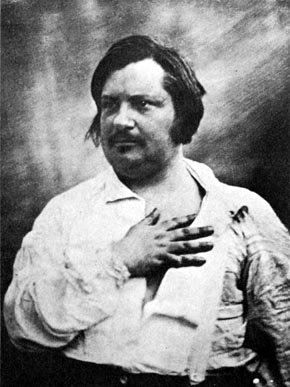
It is well known that Balzac was crucial in the romantic relationship between literature and coffee. He was not only a brave coffee drinker, but was also praising this beverage brought from the New World a couple of centuries before. He was drinking up to 50 cups per day, some say.
One day, short after his wedding, Victor Hugo visited him. That night Balzac died. Some say, that disease had somehow caused by the coffee. Who knows.
I haven't read Balzac, and I haven't drink coffee in my life, except in both cases for little exceptions. I don't like hot beverages like coffee or tea, I prefer a hot soup.
But I have read almost all novels by Jules Verne. I don't know if he liked coffee, or not, but he loved writing about crackers. In most of his adventure novels, in the first chapters, when he is describing the supplements needed for the expedition or adventure about to start, people never ever forget to pack many pounds of crackers.
Crackers were invented in Massachusetts by a certain Theodore Pearson of Newburyport in 1792, and comercialized 9 years later. By 1810 they were a big success among sailors and soldiers. Another product from the New World with which a French novelist falled in love with.
And me as well. I devour them. Saladitas Santos (now owned by Gamesa and comercialized only as "Saladitas") seemed to me the biggest invention, and for decades I was unable to find something similar -- even though I have tried tons of crackers of all styles and brands.
Till last week, when I realized that Saladitas Santos might be a copy of Italian crackers. They have almost the same shape and size, the same salty, dried flavor, and almost the same package. Now I start to suspect that Saladitas Santos is a copy of some Italian crackers.
Visited Siena last Sunday for the first time. One of the nicest cities where there is "nothing" to see, like in bloody (and overrated, and dirty, and crowded) Florence, except for the city itself. Siena is not a city to go and see things, but to enjoy the atmosphere, a place to stay, a small city to be in. To sit and let the time fly away, and fade...
The Piazza del Campo was paved in 1349, and it has a kind slope. A similar slope is in front of Parisian Centre Pompidou. Who knows if that is a coincidence or not.
"Oliver was a young lawyer, fresh from the schools, who had gone out to the deserts of Nevada to begin life. He found that country, and our ways of life, there, in those early days, different from life in New England or Paris. But he put on a woollen shirt and strapped a navy revolver to his person, took to the bacon and beans of the country, and determined to do in Nevada as Nevada did. Oliver accepted the situation so completely that although he must have sorrowed over many of his trials, he never complained -- that is, he never complained but once. He, two others, and myself, started to the new silver mines in the Humboldt mountains -- he to be Probate Judge of Humboldt county, and we to mine. The distance was two hundred miles. It was dead of winter. We bought a two-horse wagon and put eighteen hundred pounds of bacon, flour, beans, blasting-powder, picks and shovels in it; we bought two sorry-looking Mexican "plugs," with the hair turned the wrong way and more corners on their bodies than there are on the mosque of Omar; we hitched up and started. It was a dreadful trip. But Oliver did not complain. The horses dragged the wagon two miles from town and then gave out. Then we three pushed the wagon seven miles, and Oliver moved ahead and pulled the horses after him by the bits. We complained, but Oliver did not. The ground was frozen, and it froze our backs while we slept; the wind swept across our faces and froze our noses. Oliver did not complain. Five days of pushing the wagon by day and freezing by night brought us to the bad part of the journey -- the Forty Mile Desert, or the Great American Desert, if you please. Still, this mildest mannered man that ever was, had not complained. We started across at eight in the morning, pushing through sand that had no bottom; toiling all day long by the wrecks of a thousand wagons, the skeletons of ten thousand oxen; by wagon-tires enough to hoop the Washington Monument to the top, and ox-chains enough to girdle Long Island; by human graves; with our throats parched always, with thirst; lips bleeding from the alkali dust; hungry, perspiring, and very, very weary -- so weary that when we dropped in the sand every fifty yards to rest the horses, we could hardly keep from going to sleep -- no complaints from Oliver: none the next morning at three o'clock, when we got across, tired to death.
Awakened two or three nights afterward at midnight, in a narrow canon, by the snow falling on our faces, and appalled at the imminent danger of being "snowed in," we harnessed up and pushed on till eight in the morning, passed the "Divide" and knew we were saved. No complaints. Fifteen days of hardship and fatigue brought us to the end of the two hundred miles, and the Judge had not complained. We wondered if any thing could exasperate him. We built a Humboldt house. It is done in this way. You dig a square in the steep base of the mountain, and set up two uprights and top them with two joists. Then you stretch a great sheet of "cotton domestic" from the point where the joists join the hillside down over the joists to the ground; this makes the roof and the front of the mansion; the sides and back are the dirt walls your digging has left. A chimney is easily made by turning up one corner of the roof. Oliver was sitting alone in this dismal den, one night, by a sage-brush fire, writing poetry; he was very fond of digging poetry out of himself-- or blasting it out when it came hard. He heard an animal's footsteps close to the roof; a stone or two and some dirt came through and fell by him. He grew uneasy and said "Hi! -- clear out from there, can't you!" -- from time to time. But by and by he fell asleep where he sat, and pretty soon a mule fell down the chimney! The fire flew in every direction, and Oliver went over backwards. About ten nights after that, he recovered confidence enough to go to writing poetry again. Again he dozed off to sleep, and again a mule fell down the chimney. This time, about half of that side of the house came in with the mule. Struggling to get up, the mule kicked the candle out and smashed most of the kitchen furniture, and raised considerable dust. These violent awakenings must have been annoying to Oliver, but he never complained. He moved to a mansion on the opposite side of the canon, because he had noticed the mules did not go there. One night about eight o'clock he was endeavoring to finish his poem, when a stone rolled in -- then a hoof appeared below the canvas -- then part of a cow -- the after part. He leaned back in dread, and shouted "Hooy! hooy! get out of this!" and the cow struggled manfully--lost ground steadily--dirt and dust streamed down, and before Oliver could get well away, the entire cow crashed through on to the table and made a shapeless wreck of every thing!
Then, for the first time in his life, I think, Oliver complained. He said,
"This thing is growing monotonous!"
Then he resigned his judgeship and left Humboldt county."
I am posting now from this very building on the top of San Domenico's hill, between Florence and Fiesole. The history of the area is interesting. Some followers of Saint Peter were executed in the first century where the church now stands: Saint Romulus and his friends. (Mark Twain observes that in Roman times, the government was offering to the people violent amusement while taking rid of their new "enemies", the Christians, in order to protect their own interests). Then Cosimo de' Medici (the Elder) decided to build a bigger church, this one on the pic.
But the family de Medicis had troubles and decayed. Till Charles V helped them and restored the old name of the family. At that very time, Filipinos, people from Tierra del Fuego up to Colorado or even Montana, people from Cádiz and south Germany, people from Florence, all of them were under the same flag and crown and scepter. That accounts to a first and political globalization.
Then Cosimo (the Younger) build also his library next to the church, the building on the left, today it belongs to the European Institute University and a community of two friars. Here is where I am now, in the library, full of Ph.D. students from all different countries, most of them Europeans.
The Habsburg Empire under the rule of Charles V is the most impressive "globalization" considering the technical limitations. Such a huge territory couldn't be governed by a single head. But it is still a strange feeling to consider that once upon a time the people living here and the people living in Mexico belonged to a single "country".
The predict of Saint Peter and the blood of Saint Romulus began long before the Habsburg another kind of (religious and political) pre-globalization: Christianity. The Spanish Empire of the XVIth century was built on it. Somehow here, on this hill, are some of the oldest roots...
Some weeks ago, FAZ newspaper asked me to go to the Amazonas and check the situation there between the indigenous groups, the oil companies, and the ecoturism. I am still working on my report, but Lloyd Alter posted something already about our trip in the famous blog Treehuger, as well as some pics of the fauna we saw there.
The sloth on the picture is important. While swimming in a little lake full with piranhas and caimans, the people in the shore started yelling: "Caiman, caiman!". Two guys jumped out of the water in half a second, but it was this sloth you see there. It had fallen into the water, was exhausted and close to get drowned, so some guys saved him.
The thing is that caimans eat fishes (specially piranhas) and small mammals. They rarely attack humans. And they sleep during the day. Piranhas just attack if there is blood. Since there was no blod and it was during the day, I swam for more than 20 minutes in the lake. An experience full of adrenaline, in any case.
This afternoon I finally went to the Uffizi. It is a shame! If you hadn't reserved your tickets online, you wait hours in the queue. In any case, they are expensive (plus the reservation charges). Anyways. The paintings are ok (full of saints, as Mark Twain was complaining). The sad thing is that the explanations are missing: with such a great collection (and those prices and a constant flow of visitors from all countries), they should have a friendly and more professional museography, instead of those domestic pieces of paper printed 15 or 20 years ago. It is so bad, that some funny guy damaged a Botticelli with masking tape. The sign to visit the "area" reserved to Caravaggio is an A4 paper in plain Arial fonts.
Italy should be ashamed of treating this art pieces so badly.
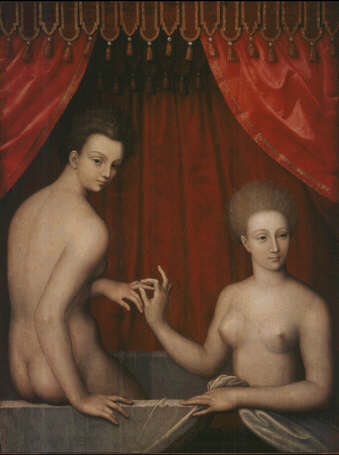
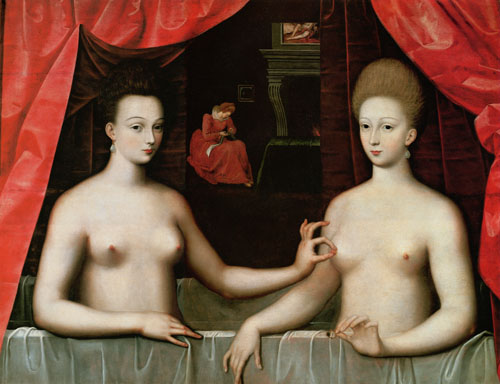
Interesting was to "discover" another portrait of Gabrielle d'Estrées, Duchess of Beaufort and Verneuil, Marchioness of Monceaux, Lover of the King Henry IV. She is the one who convinced the King to end the religious wars. "Paris is well worth a Mass", he famously replied. A similar portrait is in the Louvre, with Gabrielle and her sister are also taking a bath.
Cerca de Latacunga, en los Andes ecuatorianos, veo una bandera con los colores del arcoiris. Supongo que es casa de unos gays, pero luego veo otra, y otra, y otra, hasta que me explican que es la bandera del partido Pachakutik, de raigambre indígena. Viéndola con atención es mínima la diferencia con la bandera gay: tiene una línea violeta abajo. (Acorde, supongo, a la discusión sobre el cian y el índigo ocasionada por Newton, quien quería a fuerzas que fueran siete los colores primarios para que cuadraran con las notas musicales, los planetas, los días de la semana, y, así, incorporó el índigo.)
Otros muchos ejemplos de arcoiris ondeantes, como la italiana de la Pace, que colgaba de todos los balcones cuando Bush comenzó sus contraataques después del 11 de septiembre.
Y ésta es la bandera propuesta por Rem Koolhaas para la Unión Europea, basada a su vez en las banderas de los países.
Esta observación minuciosa de los colores del arcoiris me recuerda anthelion que vi el pasado 2 de abril en los suelos aún húmedos de los valles toscanos. No pude tomar ninguna foto, pero era algo parecido a esto que se ve acá abajo.
Last week I had to be in five different airports: the biggest one being Heathrow, the smallest one was Quito's VIP terminal (VIP doesn't stand for Very Important People, it is just the name of the airline), which is as small as my flat. All in all I spent like 30 hours of the last week in airports. A lot. Very bad for people like me who doesn't like them.
Airports have something repulsive. They are places of transit, being the rolling bands their perfect symbol: going, coming back, going, rolling, moving always in or out, the only two movements allowed: ir y venir, hin und her. Period. Too much movement contrasts with the limitation of those two possible movements. That is exactly why people move so fast, trying to get out of the airport as soon as possible, since it is not more than a necessary condition in order to be there, in the desire destination (where all kinds of movements are possible: up and down, in circles, left or right, backward and forward, zigzag...).
Now, airport designers are trying (unsuccesfully) to make them "a nice place to stay" or "to spent the time". That is a contradictio in terminis, since an airport is by itself a temporary place. But since there is always an exception to confirm the rule, Sir, Alfred Mehran's lived 18 years in the Terminal 1 of Parisian airport Charles de Gaulle.
The same can be said about bridges: two directions to go, a "place" to connect to real places. Following the "stay-in-the-airport-philosophy", some architects want to transform bridges into places of staying, specially in China. One of these bridges "should provide for a dedicated space on the river, a room over the water, more than merely acting as an engineering device that solves a communication problem." Mexican architect Fernando Romero finished already one in Jinhua City, China, and is working on another similar project in Matamoros, Mexico.
(The Ponte Vecchio is an exception worth of mentioning, since it has always hosted some houses and shops.)
Some of the most beautiful (Chinese) bridges are the lángqiáo, built by the Dong people. They serve the basic purpose of crossing a river in order to join two shores. Plus: The roofs offer a shelter for wind and rain. They are beautifully designed, and are not intellectually pretentious.
This way or that way, as you wish, just keep walking. Do not stop. Not in airports and bridges.
Just came back from Amazonas and the Andes. I missed two creatures I was looking forward to see: the river dolphin (I was indeed in the area, but they left some time ago up the river due to the oil pollution), and the transparent butterfly, which I could just see on pics. That reminded me of the fish with transparent head, and other transparent creatures.
I have been doing many stuff, and was unable to write on the blog. I will be for the next two weeks, since I am leaving for the Amazonas next Sunday. I wasn't really aware what does the word "Amazonas" mean. One third of all species live there, and it is as big as Europe. The mouth of the Amazonas river is as wide as long is the Thames.
I am visiting some Kichwa communities in the Amazonía (the Ecuadorian Amazonas). That is exactly why I have been reading Jorge Icaza's novel masterpiece, "Huasipungo". It is very well written, he has a great phrasing, and it's worth to read it. It is (one of the) first novels to denounce the brutal explotation of the Indians. The Russians were at that time really into class-fights, so they were the first to translate this book.
Unfortunately, we, Mexicans, are big ignorants of the South American reality. This is a generalization, which many might deny --with good reasons--, but at least when I was in school there was no interest in the story of South America. I hope that this trip will fill a big hole of ignorance.
Scholastic theologians were thinking hard were could be the paradise, the Heaven. It must be a geographic place, since Jesus resurrected and Mary was taken there with her body.
Columbus knew this issue. The next quote is taken from Columbus' log of his first trip to America:
THURSDAY, FEBRUARY 21 (1493)
"He [Columbus] says he was astonished at such bad weather as there was in those islands and regions, because in the Indies he navigated all that winter without anchoring and it was good weather all the time, and that, for one hour alone he did not see the sea so that he could not navigate well, and in these islands he had experienced such a serious tempest and the same happened to him on his departure as far as the Canary Islands: but having passed them, he always found the winds and the sea very temperate.
In conclusion the Admiral says that the sacred theologians and learned philosophers well said that the earthly Paradise is at the end of the Orient, because it is a most temperate place. So that, those lands which he had now discovered, are {he says} the end of the Orient".
20 years ago it was really hard to go from East Berlin to West Berlin. In all these years, many things have changed. The Lehrter Bahnhof is today the biggest train station in the world, and in the Friedrichstrasse station there is a Burger King.
But ironically, today is impossible to make that trip, since the S-Bahn in Berlin is working just on a third of its capacity due to technical revisions on most of the trains, and the closed the traffic between East and West.
Two towers which should be the tallest of their countries: on the left, Torre Bicentenario, designed by Rem Koolhaas, to be constructed in Mexico City; on the right, the U2 Tower, designed by Norman Foster, to be constructed in Dublin.
Koolhaas' project is allegedly inspired in the Maya pyramids, has an entrance for light and air (yellow hole), bla bla bla... Foster's project undertakes the old studio of U2, has luxury flats but also social and affordable departments, has a solar panel, allows the traffic to go through it, bla bla bla...
Due to legal (and financial) problems, none of the projects is under construction. Strange, though, since both projects --by two well-known Pritzker-architects-- are related to and supported by rich people: Fernando Romero (who is married to Carlos Slim's daughter) and the crew of U2.
Strange, also, that the two buildings look so similar...
"Just in this one matter lies the main charm of life in Europe - comfort. In America we hurry - which is well; but when the day's work is done, we go on thinking of losses and gains, we plan for the morrow, we even carry our business care to bed with us, and toss and worry over them when we ought to be restoring our racked bodies and brains with sleep. We burn up our energies with these excitements, and either die early or drop into a lean and mean old age at a time of life which they call a man's prime in Europe. When an acre of ground has produced long and well, we let it lie fallow and rest for a season; we take no man clear across the continent in the same coach he started in - the coach is stabled somewhere on the plains and its heated machinery allowed to cool for a few days; when a razor has seen long service and refuses to hold an edge, the barber lays it away for a few weeks, and the edge comes back of its own accord. We bestow thoughtful care upon inanimate objects, but none upon ourselves. What a robust people, what a nation of thinkers we might be, if we would only lay ourselves on the shelf occasionally and renew our edges!
I do envy these Europeans the comfort they take. When the work of the day is done, they forget it. Some of them go, with wife and children, to beer hall and sit quietly and genteelly drinking a mug or two of ale and listening to music; others walk the streets, others drive in the avenues; others assemble in the great ornamental squares in the early evening to enjoy the sight and the fragrance of flowers and to hear the military bands play - no European city being without its fine military music at eventide; and yet others of the populace sit in the open air in front of the refreshment houses and eat ices and drink mild beverages that could not harm a child. They go to bed moderately early and sleep well. They are always quiet, always orderly, always cheerful, comfortable, and appreciative of life and its manifold blessings. One never sees a drunken man among them. The change that has come over our little party is surprising. Day by day we lose some of our restlessness and absorb some of the spirit of quietude and ease that is in the tranquil atmosphere about us and in the demeanor of the people. We grow wise wise apace. We begin to comprehend what life is for".
Edge's girl made this afternoon a nice picture of him before the concert in Berlin in his private library.
Tonight is the big concert in Berlin. U2 - 360º :: It's a beautiful day!
Today I have been watching U2's concert in Mexico City in 1999. I remembered that night. I had no tickets, but managed to go there with LAS and OC. The sound outside was perfect due to the Palacio de los Deportes architecture. In order to catch a glimpse we climbed a wall, but after 5 minutes we decided to move somewhere else. Perfect timing! The police came to kick them down.
I had a ticket for the concert in Munich in 2005. Keane opened the concert. But that very day I missed it, since I was in Cancún (couldn't arrange the flight). Damn! And when the Vertigo Tour reached Mexico, I was already in Germany. Damn it again!
But tonight we will be rocking there!
Here one of the best songs, that memorable night in front of the Palacio de los Deportes.
B called the other day to ask if I would like to take her flat, since she is going to Princeton. The flat is great, and is in Prenzlauer Berg, the hipster-bobo-Bezirk of Berlin. I have been looking forward to live in PrenzelBerg, so I hope we can arrange everything.
Zehlendorf is nice, and green and calm, and full of lakes, but it has been already a while here, and a change might be positive in many senses.
PrenzelBerg is well-known as being the area with the biggest concentration of children in the whole country. It is lively, full of people, cafés, bookstores, parks, foreigners, and, it is believed, of ideas and creativity. Let's test it!
The "problem" of it has been perfectly put by Dave Turov:
"Man braucht in Berlin viel weniger Geld, um durchzukommen, als ind anderen Städten. Deshalb ziehen viele Maler, Designer und andere Kreative her. Aber das ist auch ein Problem. Viele Leute denken, Berlin sei dieses kreative Utopia, so ist es aber nicht. Man muss sehr diszipliniert sein, wenn man es hier zu was bringen will. Es ist sehr schwierig, hier produktiv zu sein. Viele Leute machen schlicht gar nichts. Die hängen einfach rum und leben, wie es kaum eine Generation vor uns konnte. Es ist ein großes Privileg, so abhängen zu können, dür nichts kämpfen zu müssen. Ich weiß genau, wovon ich rede, ich habe selbst eine Menge Zeit verschwendet, weil ich an diese Ich-bin-so-kreativ-und-gerade-nach-Berlin-gezogen-Gechichte geglaubt habe. In New York ist es anders. Da schwimmst du oder gehst du unter. Da kann es ganz schnell gehen: Erst kommst du zu spät zur Arbeit, dann verlierst du deinen Job, dann kannst du diene Miete nicht zahlen, dann verlierst du deine Wohnung, und dann bist du am Ende. Hier ist das einfacher. Wenn du gerade kein Geld hast, zahlst du diene Miete eben später, oder du ziehst zu einem Kumpel, weil die Wohnungen eh so riesig sind, dass genug Platz für alle ist. Aber diese Freiheit kann sehr trügerisch sein. Wenn man nicht diszipliniert ist, kann man sich in Berlin leicht verlieren".
(Tobias Rapp, Lost and Sound, pp.97-98.)
That's completely true, specially in PrenzelBerg. That might be a reason why the new PrenzelBerg-star Sandra Naujoks is. She is rich, millonaire, has impressive eyes, drinks coffee in the cafés, walks around, and plays poker.
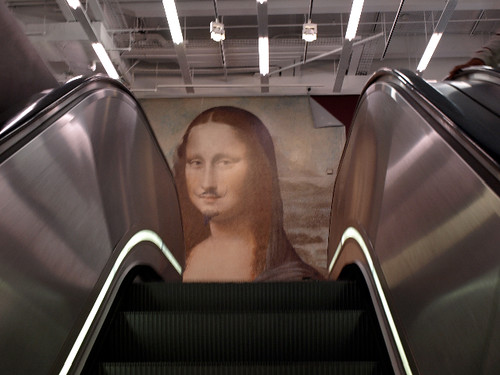
In 1867 Mark Twain visited Paris for the first time and wrote many memorable pages about the Eternal City. From all those pages, just a little paragraph was dedicated to the Louvre, which he didn't like at all. I guess he had had prefer to see Duchamp's L.H.O.O.Q.
"We visited the Louvre, at a time when we had no silk purchases in view [ironic remark on something that happened to the group the previous days], and look at its miles of paintings by the old masters. Some of them were beautiful, but at the same time they carried such evidences about them of the cringing spirit of those great men that we found small pleasure in examining them. Their nauseous adulation of princely patrons was more prominent to me and chained my attention more surely than the charms of color and expression which are claimed to be in the pictures. Gratitude for kindnesses is well, but it seems to me that those artists carried it so far that it ceased to be gratitude and became worship. If there is a plausible excuse for the worship of men, then by all means let us forgive Rubens and his brethren".
I saw the concept Umweltzone yesterday for the first time exactly when we were entering a bottleneck due to a construction. "Umweltzone: Wir bauen Zukunft!" - something like "Ambiental Zone: We construct future!".
The programm Umweltzone will start next year in several cities of Germany. It is a more sophisticated version of the Mexican program Hoy no circula (just make 2 clicks to compare both pages: it is really hilarious!).
The Mexican programm is really difficult to know in detail as it is full of exceptions, and has been proved to be more a political game than anything else. The German one seems to be also annoying to the consumers, since is focused on the CO2 emissions: if your car expels more than x, we don't want you here: either buy a better car, ride your bike, or use public transport.
Mexican public transport is not as good as the German one, and in Mexico City there are far less subway lines than, say, in Munich, which is like 15 times smaller.
The only detail I really prefer from the Mexican system is the expression "huella de carbono", which sounds much better than the stupid and impractical CO2-Emissionen (CO2 emissions in English): here for instance is impossible to write the 2 in a proper way. At least we have that!
This is the automobile landscape 101 years after Flivver. Thank you so much, Mr. Ford!
Hará unas tres semanas que vi esto en la página de la Academia Mexicana de la Lengua:
Me llamó la atención que faltaran la ch (che) y la ll (doble ele). Así que, bastante enfadado, envié de inmediato una queja a la Academia solicitando una explicación. A falta de respuesta, el asunto ya se me había olvidado hasta hoy, que casualmente encontré una copia de la carta que envié. Me puse a investigar al respecto.
Sucede que en 1994 se celebró, después de muchas dificultades, el X Congreso de la Lengua:
Ante la imposibilidad de la Academia Filipina de organizar el décimo Congreso de la Asociación, el turno pasó a la Panameña, que aceptó la invitación que le hiciera la Comisión Permanente: sería en la capital panameña en 1993. Sin embargo, circunstancias poco favorables impidieron que este proyecto se llevara a cabo. Salió al camino la Academia Puertorriqueña, ofreciéndose para organizar el encuentro, en caso de que ninguna otra Corporación estuviera en condiciones de hacerlo. Pero las buenas intenciones no fueron suficientes. Por fin, la Real Academia Española, en una solución de urgencia para que no se paralizara la tradición de estos encuentros internacionales, decidió ser la anfitriona.
En tan apurado congreso se decidió seguir considerando y dejar de considerar (¡¿ !?) a la ch y la ll como letras. Es decir: para efectos de "abecedario", los dígrafos siguen siendo letras per se. Pero para efectos de ordenamiento alfabético, se deben subsumir bajo la c y la l, respectivamente.
Dizque para facilitar el entendimiento con otros idiomas. ¡Vaya babosada! Si a ésas vamos, eliminiaríamos tantas cosas de nuestra lengua. ¡Definitivamente no contábamos con su astucia!
El Diccionario Panhispánico de Dudas explica:
abecedario. 1.Para designar la serie ordenada de las letras con que se representan los sonidos de una lengua, pueden usarse indistintamente los términos abecedario y alfabeto. Como las demás lenguas románicas, el español se sirvió básicamente de la serie alfabética latina, que fue adaptada y completada a lo largo de los siglos. El abecedario español está hoy formado por las veintinueve letras siguientes: a, b, c, ch, d, e, f, g, h, i, j, k, l, ll, m, n, ñ, o, p, q, r, s, t, u, v, w, x, y, z
y define:
ch. 1. Dígrafo que, por representar un solo sonido, es considerado desde 1803 cuarta letra del abecedario español
antes de ir a los detalles:
2. Esta variante española del alfabeto latino universal ha sido utilizada por la Academia desde 1803 (cuarta edición del Diccionario académico) en la confección de todas sus listas alfabéticas. Desde esa fecha, los dígrafos ch y ll (signos gráficos compuestos de dos letras) pasaron a considerarse convencionalmente letras del abecedario, por representar cada uno de ellos un solo sonido. No obstante, en el X Congreso de la Asociación de Academias de la Lengua Española, celebrado en 1994, se acordó adoptar el orden alfabético latino universal, en el que la ch y la ll no se consideran letras independientes. En consecuencia, las palabras que comienzan por estas dos letras, o que las contienen, pasan a alfabetizarse en los lugares que les corresponden dentro de la c y de la l, respectivamente. Esta reforma afecta únicamente al proceso de ordenación alfabética de las palabras, no a la composición del abecedario, del que los dígrafos ch y ll siguen formando parte.
Se vea por donde se vea, estamos de la xingada... ¿Y ahora, quién podrá salvarnos?
This morning, I woke up, and the first word I read in that internal black screen we all have was "WEG", written in white fonts, the German word for "OUT". I opened my eyes and checked the time: 6am. I could hear the birds singing and saw the light outside. The day had already begun, but I could notice that it wasn't that clear. Stood up and went WEG.
AK told me once that there is a pound close to my place, so I decided to go to the forest and check it. No horses, no sheeps on my way. Just a very sleepy Asian woman delivering already some flyers house by house. Strange! Anyways... I found the pond in the middle of the forest and enjoy the troll.
Nobody, no noises, just birds, wind, that what we use to call Nature. Since I came back from the Azores I have been thinking much more about our (dis)connection to Nature. I remember when I was a kid, taking the small road into the wild, just 400 meter from our home, with N, our Huasteca nanny, and a machete to cut nopales to make quesadillas for dinner. Or going to the garden and eat peaches in sommer or figs before autumn without end. Or asking M to climb the palm and cut some coconuts for us.
Well, this morning I discovered a cherry-plum tree next to that pond (I just read that it comes from the Balkans!). It was very clean and fresh, and all the leaves were covered by little drops of water. The fruits were so good, that I ate in situ more than a kilo, and I brought home one additional kilo. On my way back, a big and yellow ball of fire was waking up. There was some kind of mistake. I came home, after one hour of walking in the forest, and it was only 5am.
So poor is my connection to Nature: I cannot be sure of the hour without a watch, despite all the signs. Unfortunately!
The sun of this morning and my thoughts about Nature reminded me of this portrait of poet James Edward, by Magritte. Here a short poem by him, who also lived in San Luis Potosí, falled in love with a Huasteca woman, and build a surrealist garden in Xilitla:
“I have seen such beauty as one man has seldom seen; therefore will I be grateful to die in this little room, surrounded by the forests, the great green gloom of trees my only gloom - and the sound, the sound of green. Here amid the warmth of the rain, what might have been is resolved into the tenderness of a tall doom who says: 'You did your best, rest - and after you the bloom of what you loved and planted still will whisper what you mean. And the ghosts of the birds I loved, will attend me each a friend; like them shall I have flown beyond the realm of words. You, through the trees, shall hear them, long after the end calling me beyond the river. For the cries of birds continue, as - defended by the coretege of their wings - my soul among strange silences yet sings.”